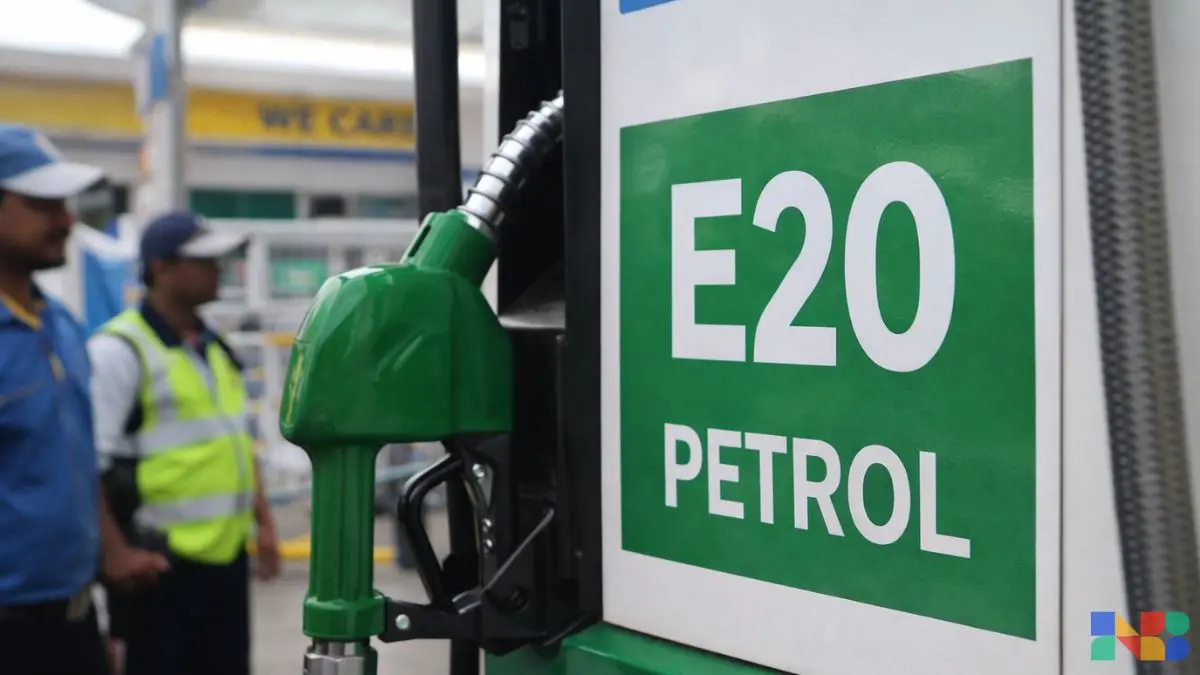
For millions of Indian vehicle owners, E20 petrol is no longer an abstract policy phrase. It is now part of everyday life at the fuel pump. Many people first noticed it on nozzles and receipts. Then came the real questions: Will it hurt my bike or car? Why is mileage falling? Is it really greener? And if ethanol is cheaper and made in India, why do consumers still feel they are paying more for less?
These are fair questions. And they deserve straight answers.
India’s ethanol-blending journey has moved at remarkable speed. Under the Ethanol Blended Petrol Programme, the country advanced its 20% blending target from 2030 to Ethanol Supply Year 2025-26 through the 2022 amendment to the National Policy on Biofuels. By 31 July 2025, average blending had already reached 19.05%, with July 2025 touching 19.93%, showing that the target was effectively within reach before 2026.
That is the policy story. But the public story is more complicated.
What exactly is E20 petrol?
E20 is a kind of petrol blended with 20% ethanol. Ethanol is an alcohol-based fuel made from feedstocks such as sugarcane, maize and other approved materials. India’s push for ethanol is tied to three big goals: cutting crude oil imports, reducing emissions, and creating an additional income channel for farmers and the rural economy. The Centre has repeatedly argued that ethanol blending is both an energy-security and farm-economy measure.
The numbers explain why the government is committed to it. In ESY 2023-24, about 672 crore litres of ethanol were supplied to oil marketing companies for petrol blending. To achieve 20% blending in ESY 2025-26, India estimated it would need about 1,016 crore litres. That is not a minor change in fuel policy; it is a massive restructuring of supply chains, agriculture, refining and retail fuel logistics.
Why is the government pushing E20 so hard?
The government’s push for E20 rests on three pillars:
1. Energy security
India imports over 85% of its crude oil. Ethanol reduces this dependence.
2. Environmental goals
Blended fuel lowers emissions. Official estimates suggest over 800 lakh metric tonnes of CO₂ reduction so far.
3. Rural economy boost
Ethanol creates demand for crops and by-products. Government estimates suggest ₹40,000 crore annual payments to farmers at 20% blending levels.
There’s also a strong financial argument: India has already saved over ₹1.5 lakh crore in foreign exchange due to ethanol blending.
On paper, it is one of the most successful energy transitions India has executed in recent years.
What changed in policy and amendments?
The key turning point came in May 2022, when the Union Cabinet approved amendments to the National Policy on Biofuels. The amendments did three important things: they advanced the 20% blending target from 2030 to ESY 2025-26, widened feedstock eligibility for biofuel production, and opened more space for domestic production, including by SEZ and export-oriented units in specified cases.
The government also backed the target with operational reforms: administered procurement pricing for ethanol, GST at 5% for ethanol supplied under the blending programme, easier inter-state movement, and simplified procurement by oil marketing companies. These are not glamorous measures, but they are the machinery that turned E20 from policy ambition into a fuel-pump reality.
Is E20 safe for vehicles?
The answer depends on the vehicle.
This is where public curiosity—and concern—begins.
New vehicles (post- 2023–25 models)
Most newer vehicles are designed or tuned for E20. Automakers have gradually aligned engines to handle higher ethanol content.
Older vehicles
Here, things are less straightforward.
- Ethanol has lower energy density → can reduce mileage
- It can be more corrosive over time in incompatible engines
- Rubber and plastic components in older vehicles may degrade faster
The government maintains that material compatibility standards have been ensured, and studies show performance remains within acceptable limits.
But that assurance does not always match lived experience.
Where the public unease is coming from?
This is where the policy meets the middle class.
On paper, E20 is a national transition. In real life, it is a household cost issue. If a commuter feels mileage has dropped, that commuter does not measure energy security or biogenic carbon. They measure weekly fuel spend.
That is why E20 has triggered visible public reactions online. The Petroleum Ministry, in its own X post, acknowledged a marginal decrease in mileage, estimating around 1-2% for some four-wheelers. At the same time, critics on X raised sharper concerns. One post claimed India moved too fast without giving consumers enough compatible fuel choices. Another questioned why cost savings were not being visibly passed on to retail buyers. Yet another reflected the fear, common among many owners of older vehicles, that engines could suffer over time. These posts do not amount to technical proof, but they do capture the emotional truth of the debate: trust has not fully caught up with policy.
The real pros of E20
The benefits are real and should not be dismissed.
First, E20 reduces import dependence. Second, it deepens domestic value chains in agriculture, distilling and logistics. Third, it supports cleaner combustion and lower lifecycle emissions when produced and used efficiently. India’s broader biofuel push is also recognised internationally as a serious part of its energy-transition strategy.
Fourth, E20 has pushed the auto industry to modernise. SIAM has said the industry aligned itself for E20 material-compliant vehicles from April 2023 and for fully tuned E20 vehicles from 2025. That means fuel policy is now shaping vehicle design, not the other way around.
The cons India should not ignore
But the concerns are just as real.
The first is mileage anxiety. Even a modest drop matters in a country where two-wheelers and small cars are daily economic tools, not lifestyle choices. The second is transition fairness. New vehicles may handle E20 better, but India still has a huge older fleet on the road. The third is agricultural stress. NITI Aayog’s own roadmap noted that sugarcane remains attractive for ethanol despite having the highest water consumption per acre, while TERI has flagged possible food-security, environmental and infrastructure concerns if feedstock expansion is not handled carefully.
That is the heart of the matter. E20 is not a bad policy. But a good policy can still create bad public feeling if the transition costs are carried mainly by consumers while the long-term benefits remain diffuse.
So, what should happen now?
India should stay the course on ethanol blending, but with more honesty and better cushioning.
The government must communicate more clearly which vehicles are best suited to E20, what consumers should realistically expect in mileage, and what support is available for legacy vehicles. Oil companies should make fuel labelling sharper and easier. Automakers should stop hiding behind technical jargon and issue plain-language advisories model by model. And policymakers should consider whether tax relief, pricing transparency or calibrated consumer protection is needed where fuel efficiency loss becomes a lived burden.
E20 cannot succeed only as a government target. It has to work as a citizen-level transition.
Because in the end, the Indian public is not resisting cleaner energy. It is resisting being told that every inconvenience is imaginary.
And that, more than ethanol chemistry, is the real lesson of the E20 debate in 2026.
References
- PIB, January 2026 note on India’s energy transition and 19.05% blending status.
- PIB, May 2022 Cabinet amendments to National Policy on Biofuels.
- PIB, March 2025 reply on blending progress and support measures.
- PIB, March 2025 note on ethanol requirement, E20 compatibility and tuned engines.
- PIB, August 2025 clarification responding to E20 performance concerns.
- PIB, January and December 2025-26 updates on forex savings, CO2 reduction and farmer payments.
- SIAM statements on industry readiness for E20-compliant and E20-tuned vehicles.
- NITI Aayog roadmap and TERI report on water, feedstock and food-security concerns.
%20compact-DgXMZM5Y.png)