Mission MITRA: Why ISRO’s Ladakh experiment Matters Beyond One Space Mission?
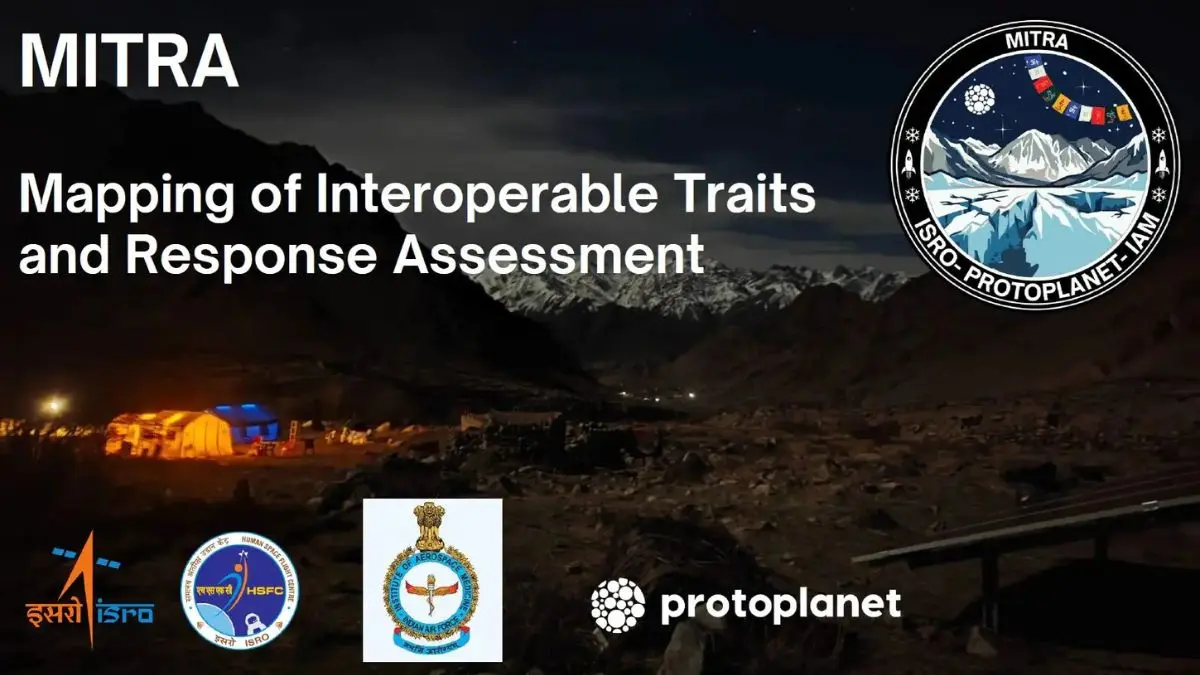
Mission MITRA is ISRO’s latest 2026 initiative in Ladakh to study crew behaviour, stress response and team interoperability for Gaganyaan.
By Srajan Agarwal | 2026-05-14T19:33:00+05:30
Key Highlights
- Mission MITRA completed in Ladakh: ISRO conducted the exercise in Leh, Ladakh, from 2–9 April 2026, at an altitude of around 3,500 metres.
- Linked to Gaganyaan: The study is part of India’s broader human spaceflight preparations and will contribute to crew performance and human-factor understanding for future missions.
- Focus on human behaviour: Unlike rocket or spacecraft tests, MITRA studies communication, decision-making, stress response, leadership and team coordination under challenging conditions.
- High-altitude analogue environment: Leh’s hypoxia, cold weather and isolation were used to simulate some of the physical and psychological pressures of spaceflight operations.
- ISRO–IAF collaboration: The mission was designed by ISRO in collaboration with the Indian Air Force’s Institute of Aerospace Medicine.
- Ground teams under study too: Reports indicate that the exercise is not only about astronauts but also about identifying and training the ground support backbone required for Gaganyaan.
- Next step: data analysis: The latest reported phase involves analysing behavioural and operational data to refine protocols, team selection, training models and future analogue exercises
For decades, India’s space story has been told through the engineers. But as the country moves closer to sending humans into space under the Gaganyaan mission, ISRO is expanding that story beyond machines.
With Mission MITRA, the focus has shifted to the human dimension of spaceflight. A spacecraft may be built with precision, but a crewed mission ultimately depends on people: their judgement, discipline, emotional resilience, ability to follow protocols, and capacity to work as one team in moments of uncertainty. That is why the rugged isolation of Ladakh has become an important testing ground for India’s space ambitions.
Mission MITRA marks a significant step in India’s preparation for human spaceflight because it recognises that success in space will depend not only on technology, but also on trust, coordination and performance under pressure.
Also Read: Skyroot Aerospace Becomes India’s First Space-Tech Unicorn After $60 Million Funding Round
https://twitter.com/IndiaToday/status/2040113683813323212
What is Mission MITRA?
Mission MITRA is a first-of-its-kind Indian study designed to assess team behaviour, crew-ground interoperability, stress response and decision-making in conditions that mimic some of the physiological and psychological hardships of space missions. ISRO has chosen Leh and the broader Ladakh region because the area offers low oxygen, cold weather, isolation and operational difficulty — all useful stand-ins for space-like stressors. ISRO’s own note says the study is intended to generate vital understanding of crew safety and performance for human spaceflight missions such as Gaganyaan. Reports on the launch of the exercise add that it will help build data on communication, resilience and group dynamics under extreme conditions.
Read Also This Article:- Gemini Intelligence on Android: Google Wants Your Phone to Do More Than Just Follow Commands
Why Now?
Because India’s human space programme is no longer just an ambition on paper. Gaganyaan has moved into a far more serious preparation phase. ISRO’s official Gaganyaan page states that the mission aims to demonstrate India’s human spaceflight capability by sending a crew of three members to a 400-km orbit for about three days and bringing them back safely into Indian sea waters. That basic mission profile has been known for some time. What has changed now is the depth of systems readiness being built around it. The programme is not just about flying a crew module; it is about preparing a complete ecosystem of launch vehicle reliability, escape systems, life support, recovery, training and mission management. Mission MITRA fits into that ecosystem.
There is also a timing signal here. ISRO’s recent updates show that 2025 was a year of intense activity for the Department of Space, with around 231 accomplishments across missions, tests and technology work. Official documents for Budget 2026–27 show that the Department of Space has been allocated ₹13,705.63 crore, up from the 2025–26 revised estimate of ₹12,448.60 crore. In other words, the Indian state is still putting more money behind its space agenda, even while expecting tangible advances. Mission MITRA should be seen in that broader context: this is preparation with intent, not symbolic theatre.
What You Need to Know About Mission MITRA
Who is involved?
Mission MITRA is being led by ISRO, particularly the Human Space Flight Centre (HSFC), with the involvement of the Institute of Aerospace Medicine and operational support from Protoplanet Pvt. Ltd., an Indian start-up handling facility management and related protocols. News reports indicate that the exercise involves India’s Gaganyaan astronaut corps and connected teams that will eventually matter in real mission environments.
What exactly is being tested?
Not a rocket, not a capsule, but the human system: endurance, teamwork, behavioural consistency, crew-ground compatibility, response under pressure and operational reliability in a harsh setting. This is important because in a crewed mission, one weak link in judgement or coordination can become a mission-threatening event.
When is it happening?
ISRO says Mission MITRA was inaugurated on 2 April 2026 and reports indicate the current phase is being conducted in the first week of April. That makes it one of the most immediate and relevant developments in India’s human spaceflight preparation this month.
Also Read:- Sony Xperia 1 VIII Announced: Expected India Price, Specs & Availability!
Where is it taking place?
In Leh, Ladakh, at an altitude of roughly 3,500 metres, where hypoxia, remoteness and climate stress create a valuable analogue environment for operational studies related to extreme missions. Ladakh is becoming, in effect, a natural laboratory for testing whether a spacefaring team can remain dependable when conditions become hostile.
Why does it matter?
Because human spaceflight is unforgiving. A country may master propulsion, navigation and module design, but still fall short if its crew systems and mission psychology are underprepared. Mission MITRA matters because it recognises that the astronaut is not just a passenger. The astronaut is part of a larger living system — one that includes mission control, support teams, medical understanding and crisis response.
How will it help Gaganyaan?
By generating real-world behavioural data that can improve training protocols, operating procedures, crew selection insights and crew-ground coordination frameworks. In simpler terms, it helps answer a question every serious spacefaring nation must answer: how do people perform when technology alone is no longer enough?
The history behind this moment
India’s human spaceflight journey has been long and patient. The political announcement gained national prominence in 2018, while the mission itself has since progressed through technology development, astronaut selection, training partnerships, abort-system testing and crew module work. One major milestone came with the TV-D1 test mission, which demonstrated the crew escape system — the critical arrangement meant to pull astronauts away from danger if something goes wrong during ascent. ISRO has also continued work on the human-rated launch vehicle and other systems needed to make a crewed mission viable, not merely aspirational.
That is why Mission MITRA deserves attention. It may not produce dramatic launch visuals, but it reflects programme maturity. Countries that succeed in human spaceflight do not think only in terms of metal and fuel. They think in terms of physiology, psychology and systems behaviour. India is now visibly entering that phase.
Read Also This Article:- National Technology Day 2026: Bharat’s Big Leap in AI, Semiconductors & Deep Tech
The larger opinion: this is the India story we should notice
There is a deeper national message here. In public conversation, India’s science story is often reduced either to nationalist pride or budget scepticism. Both instincts miss the point. The real measure of a scientific nation is not whether it celebrates launches loudly, but whether it quietly invests in the boring, difficult, untelevised groundwork that makes success credible. Mission MITRA belongs to that category.
It also tells us something about the next stage of India’s rise. The age of merely proving that India can build sophisticated machines is passing. The new question is whether India can build institutions of reliability around those machines. In aviation, medicine, defence and space, that is where great powers separate themselves from ambitious powers. Mission MITRA is a small but serious sign that India understands this.
And that, more than the acronym, is why Mission MITRA matters.
Source URL: https://news4bharat.com/bharat-2047/mission-mitra-isro-gaganyaan-ladakh-explained-2026/