Should India Privatise More PSUs? The ₹80,000 Crore Question
Should the Indian government run businesses—or should businesses run themselves? This question sits at the heart of one of India’s most persistent economic debates: privatisation of Public Sector Undertakings (PSUs).
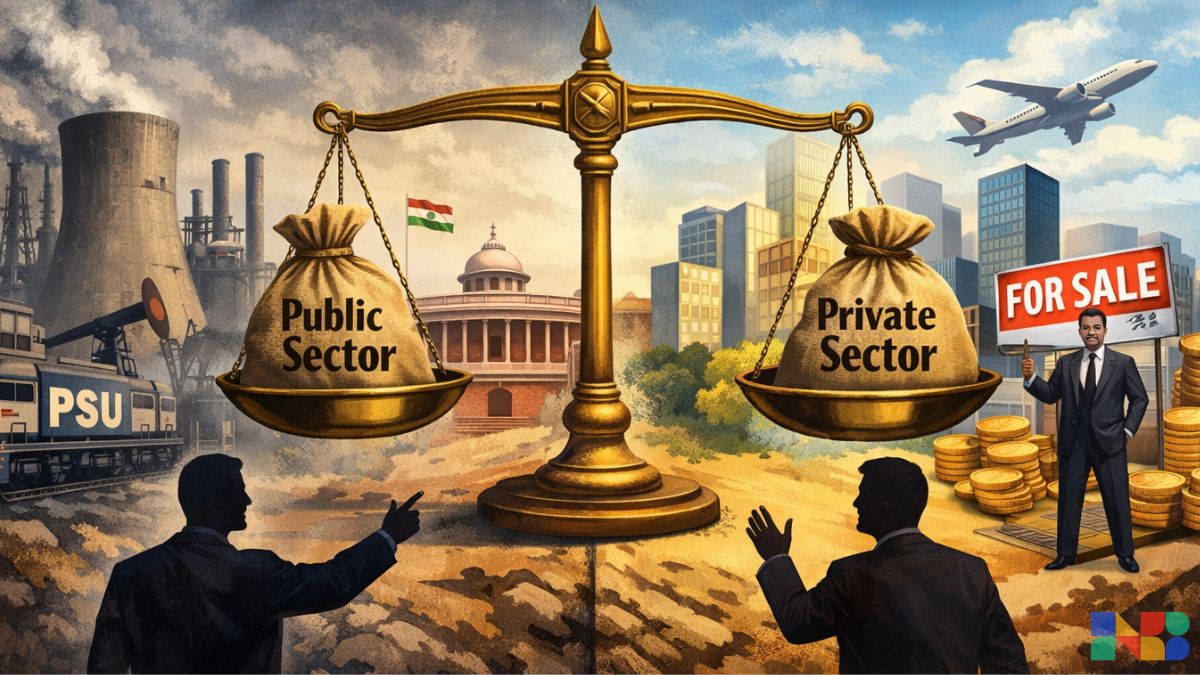
"We either privatise or we close the airline. We run a loss of ₹20 crore every day." — Hardeep Singh Puri, then Civil Aviation Minister, on Air India (March 2021)
That sentence captures the privatisation debate in India better than a thousand policy papers. It wasn't ideology — it was arithmetic. And yet, five years on, the government that made that call has quietly put nine PSUs' privatisation "in abeyance," pumped $1.5 billion into two companies it couldn't sell, and is now reviving a debt-laden steel plant with ₹10,700 crore it doesn't need to spend.
So the question hanging over India's economic policy in 2026 is not abstract: Should India privatise more PSUs? The answer, characteristically Indian, is: it depends — but far more urgently than the government is willing to admit.
Context: The PSU Empire India Built
When India gained independence in 1947, there were exactly five Public Sector Undertakings (PSUs). By March 2021, that number had ballooned to 365 Central PSUs, representing a total investment exceeding ₹16.41 lakh crore. These entities sprawl across airlines, fertilisers, shipping, steel, telecommunications, petroleum, insurance, banking — sectors both strategic and embarrassingly mundane.
The scale is staggering. CPSEs earned a combined revenue of roughly ₹24.43 lakh crore in 2018–19. Some, like ONGC and Coal India, are genuine wealth creators. Others, like BSNL and MTNL, have become synonymous with state-sponsored inefficiency — zombie companies kept alive by taxpayer transfusions.
This is the empire whose future is now being debated.
Also Read: Future of Jobs in India by 2047: AI, Automation & New Careers
The Case For Privatisation: Efficiency, Capital, and Competitive Logic
The pro-privatisation argument isn't ideological; it's empirical. Look at what happened when India actually pulled the trigger.
Air India is the most vivid example. Before its 2022 sale to the Tata Group, the airline was bleeding ₹20 crore every single day. It had accumulated losses of approximately ₹70,000 crore. Its domestic market share had cratered to 13%. Post-privatisation, the turnaround has been remarkable: Air India posted its highest-ever consolidated operating revenue of ₹51,365 crore in FY24, a 24.5% jump over FY23, and followed up with revenue of approximately $7 billion (roughly ₹58,000 crore) in FY25 — an 11% increase, while carrying 44 million passengers. It has placed orders for 570 new aircraft and is aggressively expanding internationally.
Go back further. Hindustan Zinc, privatised in 2002 under the Vajpayee government, saw its annual profits grow from ₹69 crore to over ₹8,000 crore in the years since. The government still holds a 29.5% stake now worth approximately ₹40,000 crore — meaning it earns more from residual ownership than it ever would have managing the company directly. Maruti Suzuki, handed to Japan's Suzuki Motor Corporation, now commands a 50% market share in Indian passenger vehicles. VSNL (now Tata Communications) more than doubled its revenues after privatisation.
The fiscal case is equally urgent. The Union Budget 2026–27 has set a combined divestment and asset monetisation target of ₹80,000 crore — a 135% increase over the revised FY26 estimate. That capital, freed from dead-weight PSUs, could fund infrastructure, healthcare, or debt reduction. CareEdge Ratings estimates India could raise approximately $137.75 billion just by selling minority stakes while retaining 51% control. That is not an abstraction — it is capital lying dormant inside companies that frequently underperform their listed peers.
Also Read: Viksit Bharat 2047: What India Will Look Like at 100 Years of Independence
The Case Against: Strategic Assets, Social Contracts, and the Limits of Markets
The counter-argument is not merely sentimental. It is structural.
India is not a mature market economy where private capital can be trusted to serve national goals without friction. Several sectors — defence, strategic infrastructure, rural banking, essential commodities — require a state presence not because government runs them better, but because the private sector, left alone, simply won't serve India's full geography and population at acceptable prices.
Consider rural banking. Public sector banks, despite their inefficiencies, currently serve crores of Indians in districts where private banks don't find it profitable to operate. The Jan Dhan Yojana's success, enrolling over 53 crore accounts, was built on the back of PSU bank networks. A fully privatised banking sector would likely deprioritise low-ticket, high-cost rural customers — deepening financial exclusion in a country where financial inclusion is a live crisis.
The employment argument also cannot be entirely dismissed. PSUs collectively employ millions of workers. In an economy where the formal private sector absorbs only a fraction of new entrants, wholesale privatisation without a robust labour retraining and social safety net system risks creating social dislocation. The protests against the privatisation of Vizag Steel Plant (RINL) — now receiving a ₹10,700 crore government rescue — reflected genuine anxiety in a region where the plant is the primary economic anchor.
There's also the recurring problem of buyer quality. Of the 36 CPSEs approved for strategic disinvestment since 2016, the government has completed transactions in only 10 — and a startling 8 of those were sold to other PSUs, not private buyers. True privatisation occurred in only two cases: Air India and Neelachal Ispat Nigam. This is not a ringing endorsement of market appetite. India's private capital — outside a handful of large conglomerates — lacks the depth to absorb large, complex, debt-laden industrial assets. Privatising into weak hands can be worse than retaining public ownership.
The sale of Bharat Petroleum (BPCL) was abandoned in 2022 after failing to attract suitable buyers, despite the company turning substantial profits. The ongoing privatisation of Shipping Corporation of India and BEML has been "stuck for years due to complications over transfer of land holdings." Nine companies — including Madras Fertilizers, MMTC, and NBCC — have been put "in abeyance." The government's own disinvestment track record through FY25 was to collect only ₹86.25 billion against a target of ₹180–200 billion — missing the mark for the sixth consecutive year.
Expert Opinion and Policy Signals
The Confederation of Indian Industry (CII) has called for an accelerated, "demand-led" approach with a rolling three-year privatisation pipeline. The Economic Survey 2025–26 went further, recommending amendments to allow government stakes in listed PSUs to drop below 51% — potentially to 26% — while retaining effective control through special rights like golden shares. This is a significant signal: the government may be exploring a model where it sheds operational control without ceding strategic oversight.
Economist Rajani Sinha of CareEdge framed the opportunity starkly: with PSU stock valuations at multi-year highs through much of 2024, India had a rare window to raise substantial capital through minority stake sales without full privatisation. Whether that window remains open in 2026, amid global uncertainty and geopolitical headwinds, is a question the National Monetisation Pipeline 2.0 — targeting ₹16.72 lakh crore over FY26–30 — is trying to answer through asset monetisation rather than outright sale.
Editorial Analysis: The Retreat Has Been Strategic, Not Principled
Here is what is actually happening, and why it matters.
The Modi government's retreat from its bold 2021 privatisation agenda is not ideological recalibration — it is political triangulation. After returning to power in 2024 with a reduced majority dependent on regional allies, the government faces heightened sensitivity to labour union opposition, regional employment concerns, and the optics of "selling national assets." Nine companies put in abeyance. Revival plans for companies it couldn't sell. A ₹10,700 crore bailout for a steel plant whose privatisation was met with street protests.
This is understandable as politics. It is indefensible as economics.
Every rupee spent propping up BSNL, RINL, or Pawan Hans is a rupee not spent on AIIMS beds, highway kilometres, or school infrastructure. The opportunity cost of maintaining unviable PSUs is real and large — it just doesn't show up on a protest banner. And the longer the government delays, the deeper the dysfunction embeds, the larger the liabilities grow, and the harder the eventual reckoning becomes.
What India actually needs is not an ideological commitment to privatisation or state ownership — it is a surgical, sector-by-sector framework that asks three honest questions of each PSU: Does its continued state ownership serve a genuine public purpose that the market cannot deliver? Is its current financial health sustainable without taxpayer support? And if neither is true, is the government willing to bear the short-term political cost of a necessary long-term decision?
Air India answered all three. The result — though incomplete and still loss-making at the group level — is directionally vindicated. The steel plants, the fertiliser companies, and the helicopter operators need to face the same questions, without the political insulation that has shielded them for decades.
Broader Implications: What Hangs in the Balance
The PSU question is not merely a balance-sheet argument. It has civilisational implications for India's Viksit Bharat ambitions.
A country targeting a $5 trillion economy by 2027 cannot afford to have its most capable bureaucrats managing mediocre airlines, underperforming steel plants, and defaulting telecom companies. The state's bandwidth — regulatory, financial, administrative — is finite. Every unit of state energy spent managing commercial enterprises is unavailable for building the infrastructure of governance: courts, schools, regulatory bodies, public health systems.
Privatisation, done right, does not shrink the state — it refocuses it. The countries that have done this well, from Singapore to the UK to Brazil, found that a smaller but more focused public sector actually delivers more for citizens, not less.
But privatisation done poorly — into crony hands, at distressed valuations, without competition safeguards — can be worse than state ownership. India's institutional capacity for executing complex transactions cleanly, as the BPCL and Shipping Corporation sagas demonstrate, remains underdeveloped.
Summing it UP
The debate framed as "privatise or not" is a false binary. India's PSU landscape contains genuine strategic assets that warrant permanent state ownership, chronic loss-makers that should have been wound up a decade ago, profitable companies that need capital infusion rather than sale, and everything in between.
The question is not whether India should privatise. The question is whether India has the institutional courage — the political will to override union opposition, the administrative capacity to structure clean transactions, and the regulatory framework to ensure privatised entities don't become private monopolies — to do it surgically, honestly, and fast enough to matter.
The government's ₹80,000 crore FY27 disinvestment target represents a renewed ambition. The IDBI Bank sale, if executed, will be a significant test of that intent. The Economic Survey's recommendation to lower PSU stakes to 26% is the most interesting structural idea on the table.
But ambition and action are different things. India has been here before — ambitious targets, underwhelming execution, political retreat at the first sign of resistance.
The PSU paradox is ultimately a test of whether India's reform institutions have grown up. Six years of missed disinvestment targets suggest the answer, so far, is: not quite yet.
The clock, and the debt, keep ticking.
Views expressed are editorial in nature and intended to stimulate informed debate. Data sourced from Ministry of Finance, Budget Documents 2026–27, Business Standard, Reuters, CareEdge Ratings, and the Economic Survey 2025–26.
Tags
Share this article
-B_oZyeHK.png)