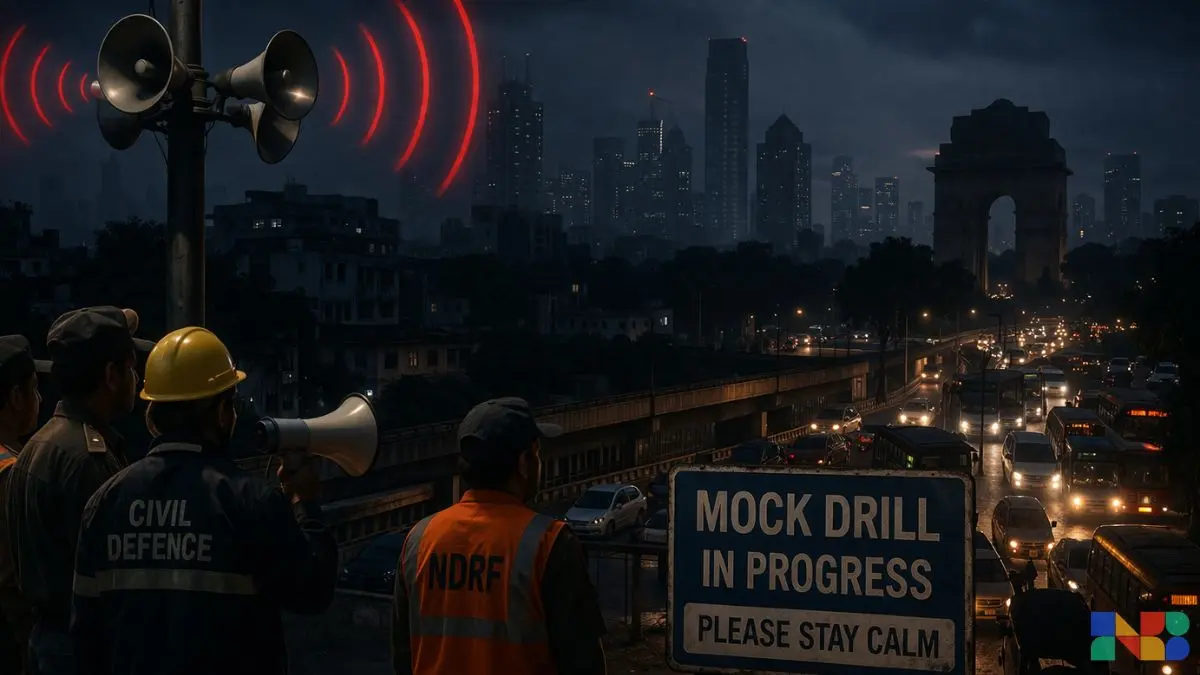
For a few minutes on Thursday evening, Delhi did something unusual—it stopped and listened.
Sirens echoed across parts of the capital. Lights went out in selected pockets. Emergency teams moved in. At several locations, residents, students and staff were guided through evacuation protocols as if a real crisis had struck.
This was not panic. It was practice.
The civil defence mock drill conducted across all 13 districts of Delhi was designed to simulate a hostile emergency scenario—testing how quickly and effectively the city can respond when the unexpected happens. From blackout protocols to coordinated rescue efforts, the drill brought multiple agencies into action: police, fire services, district administration, and disaster response teams.
But beyond the visuals and official briefings lies a more important question—what did Delhi actually learn from it?
Why mock drills matter more than they appear
A mock drill is often mistaken for a symbolic exercise. In reality, it is a stress test.
On paper, every department has a defined role during an emergency. But crises do not unfold on paper. They unfold in chaos—where seconds matter, communication breaks down, and coordination becomes the difference between control and collapse.
That is where drills come in.
Delhi, located in Seismic Zone IV and handling tens of thousands of fire and emergency calls annually, sits in a high-risk category. Its dense population, vertical housing, critical infrastructure and complex mobility networks make it especially vulnerable.
Mock drills serve three clear purposes.
First, they test response time. Can agencies act together in minutes, not hours?
Second, they prepare the public. Because in any emergency, citizens are not bystanders—they are the first layer of response.
Third, they expose weaknesses—before a real disaster does.
And that last point is crucial.
The gaps drills quietly reveal
No drill is perfect—and that is exactly the point.
Such exercises often reveal uncomfortable truths: blocked exits, lack of awareness among residents, confusion over instructions, poor signage, inadequate lighting in stairwells, or delays in coordination between agencies.
In many cases, people instinctively reach for their phones—not exits.
Crowding, misinformation, and panic are not theoretical risks; they are predictable human reactions. A mock drill allows authorities to observe these patterns without the cost of real casualties.
But observation alone is not enough. The real value lies in correction.
The advantages: building muscle memory
There is a reason disaster experts emphasise repetition.
In a real emergency, people do not rise to the occasion—they fall back on what they have practised.
Mock drills help build that muscle memory. They:
- Improve coordination between agencies
- Familiarise citizens with emergency protocols
- Reduce panic through awareness
- Strengthen institutional response systems
- Build public confidence in authorities
Residents who witnessed the Delhi drill described it as an eye-opener. For many, it was the first time they saw how different agencies operate together under simulated pressure.
That visibility matters. It turns abstract preparedness into something real.
The limitations: when drills become one-day events
However, there is a risk—and it is a familiar one.
In many Indian cities, mock drills end where they should begin.
A siren sounds. Teams mobilise. Photos are taken. Reports are filed. And then, normal life resumes—with little follow-up.
Preparedness cannot be episodic. It must be continuous.
If the Delhi exercise does not translate into:
- building-level evacuation plans
- regular RWA (Resident Welfare Association) awareness sessions
- school-level safety drills
- hospital emergency audits
- clear public communication systems
then its impact will remain limited.
A city cannot rehearse safety once a year and expect readiness year-round.
Policy push: what has changed in recent years
India’s disaster preparedness framework has evolved, at least on paper.
The Disaster Management Act of 2005 laid the foundation for structured response systems. The Civil Defence Act, originally focused on hostile scenarios, was expanded in 2009 to include disaster management roles.
More recently, the Disaster Management (Amendment) Act, 2025 has introduced key changes:
- Creation of national and state disaster databases
- Formal recognition of institutional bodies involved in disaster response
- Provision for Urban Disaster Management Authorities in major cities
- Enabling states to establish dedicated State Disaster Response Forces
These changes reflect a growing understanding that urban disasters require specialised, city-level planning.
For a region like Delhi-NCR—spread across multiple administrative boundaries—this is particularly important.
Delhi-NCR: a shared risk, a shared responsibility
One of the biggest challenges is that Delhi does not function in isolation.
Its risks are regional.
Noida, Gurugram, Ghaziabad, Faridabad—these are not separate ecosystems. They are interconnected urban zones with shared infrastructure, population flow and vulnerabilities.
A disaster in one part of NCR can ripple across the entire region.
That is why isolated drills are not enough. What is needed is a coordinated NCR-level preparedness culture—common protocols, shared communication systems, and synchronized response strategies.
Without that, preparedness remains fragmented.
What citizens felt—and what they must do next
Public reaction to the drill ranged from curiosity to confusion.
Some residents appreciated the effort, calling it necessary in uncertain times. Others questioned the inconvenience, particularly the blackout element. A few admitted they did not fully understand what was expected of them.
That last response is the most important.
Because preparedness is not just about government readiness—it is about citizen awareness.
Every household in Delhi-NCR should ideally know:
- where to assemble during an emergency
- how to evacuate safely
- whom to contact first
- how to avoid spreading panic
These are basic steps. Yet, for many, they remain unknown.
That gap cannot be filled by a single drill.
The larger picture: response vs preparedness
India’s disaster response capacity has improved significantly.
For instance, the National Disaster Response Force (NDRF) has expanded its operational strength and has saved over 1.5 lakh lives since its inception, evacuating several lakh more during disasters.
But response is only half the story.
Preparedness—especially at the community level—remains uneven.
And in dense urban centres like Delhi, preparedness is not optional. It is essential.
Opinion: a drill is only as good as what follows
Delhi’s mock drill was timely. It was necessary. It was, in many ways, effective.
But it was also just a beginning.
The success of such an exercise should not be measured by how well it was executed on one evening—but by what changes in the weeks that follow.
Do buildings update evacuation plans?
Do schools conduct regular safety sessions?
Do RWAs take ownership of local preparedness?
Do authorities share learnings transparently?
If the answer is yes, the drill has done its job.
If not, it risks becoming just another well-managed event.
A final word
A siren can alert a city for a few minutes.
But awareness, planning and participation—that is what keeps a city safe in the long run.
Delhi has heard the siren.
Now, it must decide whether to remember it.
%20compact-DgXMZM5Y.png)